

Bank Passbook Only — Can I Still Get a Home Loan?
Geeta sells bangles and costume jewellery at a weekly market in Pune. She earns between ₹800 and ₹1,200 on market days. She deposits her earnings into her savings account every week without fail. She has been doing this for nine years.
When she asked a bank about a home loan, they asked for her salary slip. She didn’t have one. They asked for her ITR. She didn’t have that either. Finally, she placed her passbook on the counter — page after page of regular deposits, nine years of consistent savings. The officer barely looked at it.
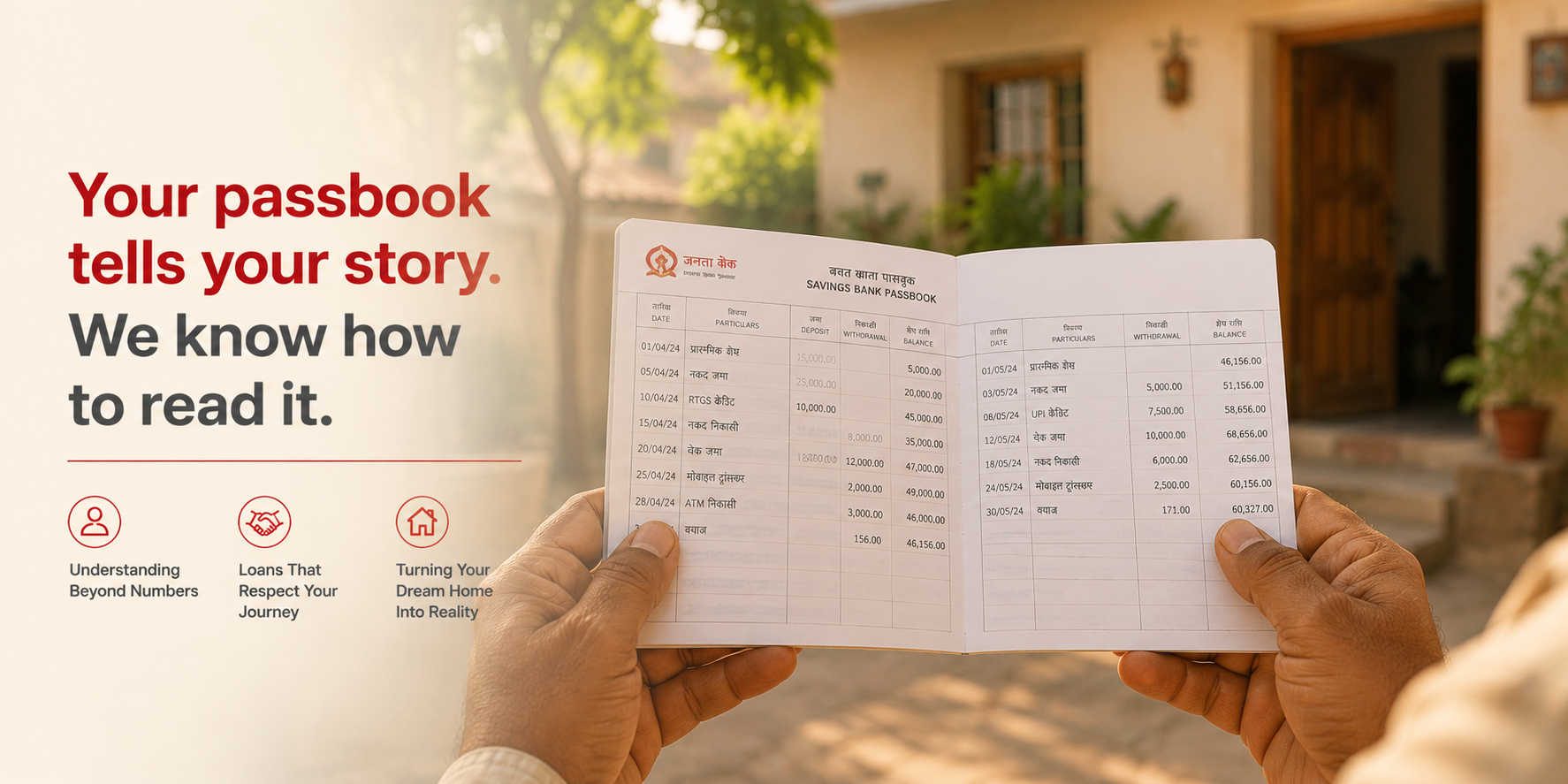
Here is what that bank officer missed. Geeta’s bank passbook is not just a booklet. It is nine years of financial discipline, captured in ink. And for lenders who know how to read it, it is a powerful income proof.
If your only formal income document is your bank passbook — this guide is written for you. Because yes, you can still get a home loan. And here is exactly how.
Why Most Banks Dismiss the Passbook
Traditional banks have built their lending processes around a narrow set of documents. At the top of that list sits the salary slip — a document that proves a fixed monthly income paid by a registered employer. Closely behind it are ITR filings and Form 16.
For the vast majority of India’s working population, none of these documents exist. According to the Periodic Labour Force Survey 2022–23 published by the Ministry of Labour and Employment, over 90% of India’s workforce is employed in the informal sector. That means over 90% of working Indians do not receive a formal salary slip every month.
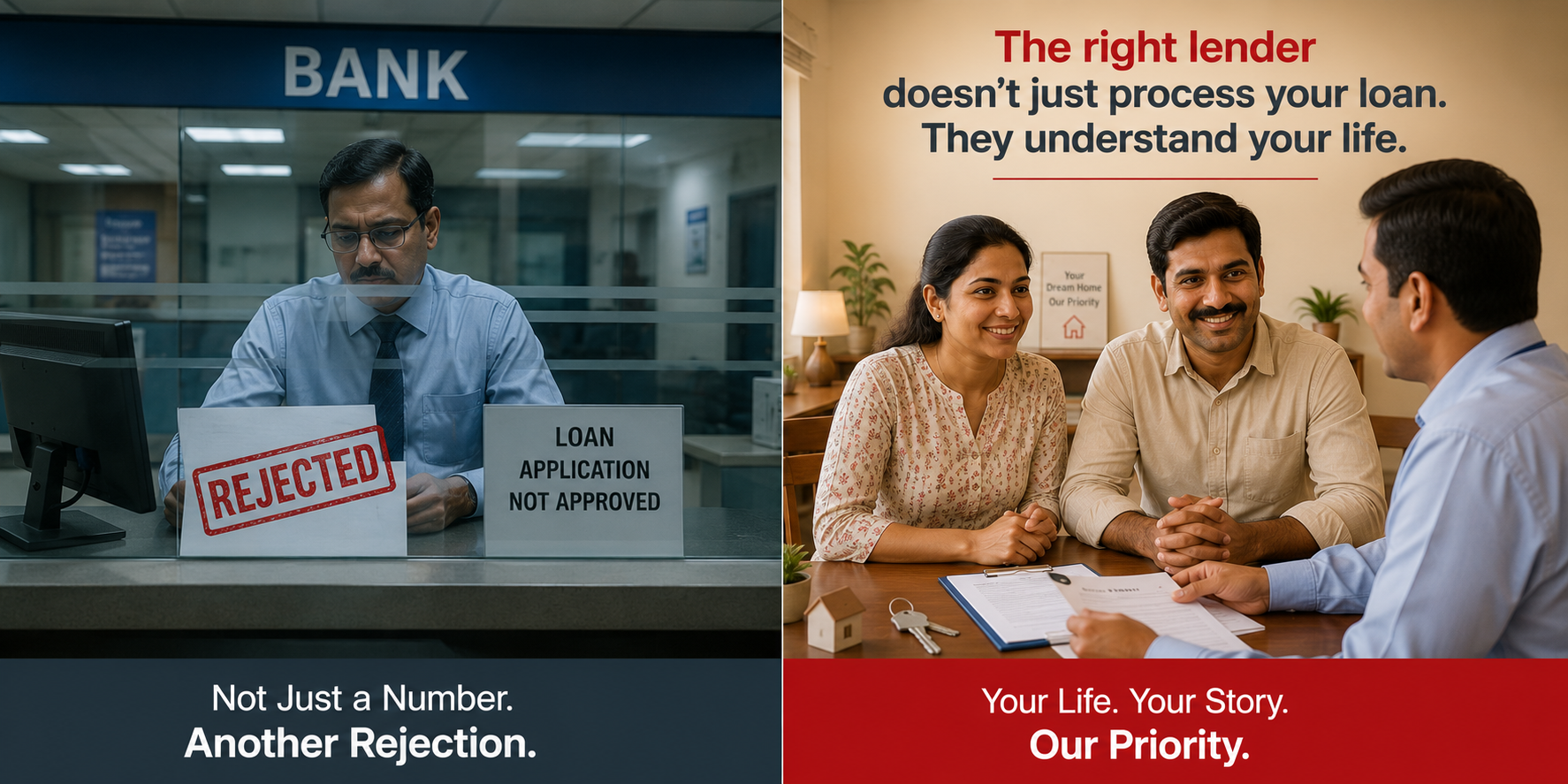
Yet banks continue to treat the passbook as an insufficient document — too informal, too variable, too difficult to process through a standard template.
However, that is a failure of the bank’s system. It is not a failure of the borrower. And it is precisely this gap that lenders like Easy Home Finance are built to close.
What Your Bank Passbook Actually Tells a Lender
When a lender truly understands informal income, a bank passbook becomes one of the most informative documents available. Here is what it reveals — if you know how to read it:
Income Consistency Regular deposits — even of varying amounts — show that you earn consistently. A passbook with credits appearing every few days tells a lender that income is active, not occasional.
Income Volume The total of monthly deposits gives a lender a working estimate of your monthly earnings. Even without a fixed salary, average monthly credits over 6 to 12 months provide a reliable income baseline.
Savings Discipline The difference between what comes in and what stays in the account shows how well you manage money. A borrower who earns ₹20,000 a month and consistently maintains a balance of ₹8,000 to ₹10,000 is demonstrating exactly the kind of financial discipline lenders want to see.
Financial Behaviour Are there sudden large withdrawals? Frequent bounced payments? Or is the account clean, predictable, and consistent? The passbook captures all of this — and it tells a richer story than a single month’s salary slip ever could.
At Easy Home Finance, we are trained to read that story. Therefore, your passbook is not just acceptable — for many of our borrowers, it is the most important document in the entire application.
What Makes a Bank Passbook Strong as Income Proof
Not all passbooks are equal in the eyes of a lender. Here is what makes yours stronger:
Duration of Transaction History A passbook covering 12 months of regular activity is significantly more valuable than one covering 3 months. Therefore, if you are planning to apply for a home loan in the coming months, start depositing consistently right now — and keep going.
Regularity of Deposits Weekly or fortnightly deposits are stronger than sporadic large deposits. Regular credits show that income is earned continuously — not occasionally or in unpredictable bursts.
Absence of Large Unexplained Withdrawals Clean outflow patterns matter as much as income patterns. Frequent large withdrawals without corresponding expenses on record can raise questions about income sources. Keep your account activity straightforward and consistent.
Average Monthly Balance Maintaining a healthy average balance relative to your income shows that you are not spending everything you earn. This suggests financial buffer — which is reassuring to any lender assessing repayment ability.
Account Age A savings account that has been active for several years carries more weight than a recently opened one. Long account history adds credibility to the income pattern it records.
What Else Can You Pair With Your Passbook?
Your passbook is your foundation. However, pairing it with even one or two supporting documents can significantly strengthen your application. Here is a practical list of what works:
Identity and Address Proof
- Aadhaar card, PAN card, or Voter ID
- Utility bill, ration card, or rental agreement
Work and Business Proof
- Trade licence or shop registration certificate
- Market committee letter or vendor association membership
- Vehicle permit or RTO badge (for transport workers)
- Udyam Registration Certificate if registered as an MSME
Supporting Income Documents
- GST returns if you are registered under GST
- CA-certified income statement or net worth certificate
- Cash memos or purchase invoices showing business activity
Credit History
- Any previous loan repayment records — microfinance, gold loan, or vehicle loan
- CIBIL score — ideally 650 or above
The more of these you can provide alongside your passbook, the clearer and stronger your overall application becomes. However, even if you only have a passbook and your identity documents, do not let that stop you from applying. Our team will work with what you have.
One Practical Step That Makes a Huge Difference
This is the single most important piece of advice in this entire post.
If you earn in cash — whether from a market stall, a home-based business, daily wage work, or any other informal source — start depositing your earnings into your bank account regularly, starting today.
You do not need to deposit everything. You do not need a minimum amount. What matters is consistency. Even depositing ₹500 or ₹1,000 every two or three days, every week without fail, builds a visible income pattern over time.
Over 6 to 12 months, this habit transforms your passbook from a thin record into a powerful financial document. It becomes your income proof, your savings proof, and your financial discipline proof — all in one.
Therefore, if homeownership is your goal for the next one to two years, start this habit immediately. It costs you nothing and it dramatically improves your eligibility.
How Easy Home Finance Assesses Passbook-Only Borrowers
At Easy Home Finance, we have designed our entire assessment process around borrowers whose income does not come with a payslip. Here is what happens when you apply:
Step 1 — You Apply in Minutes Fill out our short online form. It takes less than five minutes. No salary slip required at this stage. Start here.
Step 2 — We Call You A member of our team calls you to understand your work, how you earn, what your deposit pattern looks like, and what kind of property you are looking to buy. This is a real conversation — not a checklist call.
Step 3 — We Review Your Passbook and Supporting Documents We look at your average monthly credits, deposit consistency, account age, and savings behaviour. We assess your real repayment ability — not just whether you fit a standard template.
Step 4 — We Tell You Exactly Where You Stand We give you a clear, honest assessment. If there are gaps, we tell you what to strengthen and how. If you are ready, we move forward.
Step 5 — Sanction and Disbursal Once approved, we guide you through every remaining step — clearly, in plain language, without jargon or surprises.
Watch real borrower stories — people who applied with exactly the documents you have.
What You Should Never Do When Applying With a Passbook
Here are three common mistakes to avoid:
Do not inflate deposits artificially Some borrowers try to show higher income by transferring money between family accounts or making large one-time deposits just before applying. Lenders check for this specifically. Artificial inflation of deposits is not only ineffective — it can raise fraud concerns. Only genuine, earned income deposits matter.
Do not apply to multiple lenders simultaneously Every formal loan application triggers a hard inquiry on your CIBIL score. Multiple hard inquiries in a short period reduce your score. Therefore, choose your lender thoughtfully — rather than applying everywhere at once.
Do not wait to start building your passbook history The most common mistake is waiting until you are “ready” to apply before starting to deposit regularly. Building a strong passbook history takes 6 to 12 months. Therefore, start now — even if your application is months away.
The Bottom Line
Your bank passbook is not a consolation document. It is a genuine record of your financial life — your income, your savings, your discipline, and your consistency. For any lender who truly understands informal income, it is a powerful foundation for a home loan application.
Easy Home Finance is built specifically to serve borrowers like you — people who earn honestly, save carefully, and simply don’t have the paperwork that traditional banks demand.
Here is what to remember:
- Regular deposits over 6 to 12 months make your passbook a strong income proof
- Consistency matters more than the amount — weekly deposits beat monthly lump sums
- Pairing your passbook with even basic business or work documents strengthens your application
- Never artificially inflate deposits — genuine transaction history is what counts
- Easy Home Finance assesses informal income fairly — your passbook is a real starting point
You have been saving for this moment for years. Don’t let a missing payslip be the reason you stop.
Apply for your home loan today — your passbook is enough to get started.
Nine years of deposits. One dream. Let’s make it real.
Frequently Asked Questions
Can a bank passbook alone be enough to get a home loan in India? It depends on the lender. Traditional banks typically require salary slips and ITR in addition to bank statements. However, specialised Housing Finance Companies like Easy Home Finance are built to assess informal income borrowers and will use your bank passbook — especially when it shows consistent deposits over 6 to 12 months — as a primary income document. Pairing it with even basic identity and work proof significantly improves your application.
How many months of passbook history do I need to apply for a home loan? Most lenders assessing informal income will look for at least 6 months of transaction history. However, 12 months of consistent deposits is significantly stronger. If your passbook history is currently thin, the most practical step you can take right now is to start depositing regularly and apply in 6 to 12 months. Talk to our team to understand what works for your specific situation.
What deposit pattern makes a passbook strongest as income proof? Regular, frequent deposits — weekly or fortnightly — are stronger than occasional large deposits. Lenders look for consistency because it signals ongoing, earned income rather than one-time inflows. Additionally, maintaining a healthy average balance — rather than withdrawing everything immediately — shows savings discipline that supports repayment capacity.
What is my CIBIL score and does it matter if my only proof is a passbook? Your CIBIL score reflects your credit repayment history. A score of 650 or above significantly strengthens your application — especially when formal income documents are limited. If you have repaid any previous loan on time, that history already contributes positively. Easy Home Finance reviews your full financial profile, so a strong passbook combined with a decent CIBIL score builds a compelling case even without ITR or salary slips.
Can I apply jointly with my spouse if we both only have passbooks as income proof? Yes. Applying jointly combines both incomes and increases your total loan eligibility. At Easy Home Finance, we assess both applicants’ bank passbooks together as part of a joint application. Combined deposit histories from two accounts often present a stronger overall income picture than a single account alone. Start your joint application here.





Leave a Comment