
Buying Land? Don’t Pick the Wrong Loan — Plot Loan vs Home Loan Explained
Vikram had saved for eight years. His goal was simple — buy a plot in his hometown, build a house over the next few years, and finally give his family a permanent home.
He walked into a bank and asked for a home loan. The bank approved it. He bought the plot. Then, two years later, when he began construction, he discovered something nobody had told him. His home loan had a clause requiring construction to begin within a fixed period — failing which, the interest terms could change. Additionally, certain tax benefits he had been counting on were not available for a plot-only purchase.
Vikram’s mistake was common. And entirely avoidable.
The difference between a plot loan and a home loan is not just a matter of terminology. It is a fundamental difference in product structure, eligibility, tax treatment, and what you can and cannot do with the money. Understanding this difference before you apply can save you from costly surprises down the line.
This guide breaks it all down — clearly, practically, and without jargon.
What Is a Home Loan?
A home loan is a loan taken specifically to purchase a residential property that already has a structure on it — a flat, an independent house, a row house, or a builder floor — or to construct a house on a plot you already own.
Home loans in India are offered by banks, Housing Finance Companies, and NBFCs. They are regulated by the Reserve Bank of India and, in the case of HFCs, also overseen by the National Housing Bank framework.
The property being financed under a home loan must be residential in nature and — if under construction — must be a defined residential project or an owner-driven construction on a plot the borrower already owns.
At Easy Home Finance, home loans are our core product. We help salaried employees, self-employed borrowers, and informal income earners purchase or construct residential homes across tier-2 and tier-3 cities in India.
What Is a Plot Loan?
A plot loan — also called a land loan — is a loan taken specifically to purchase a piece of land or a residential plot. It is not for purchasing a ready property with a structure. It is purely for the acquisition of the land itself.
Plot loans are available from many of the same lenders who offer home loans. However, they are a distinctly different product with different eligibility conditions, loan-to-value ratios, tenures, and tax implications.
Importantly, most lenders restrict plot loans to residential plots. A plot loan is generally not available for agricultural land, commercial land, or plots in non-approved layouts. Additionally, most lenders who offer plot loans require that the borrower intends to construct a residential structure on the plot within a specified timeframe.
The Core Differences — Side by Side
Here is a clear comparison of the two products across the most important parameters:
| Parameter | Home Loan | Plot Loan |
|---|---|---|
| Purpose | Purchase or construct a residential property | Purchase a residential plot / land |
| Property type | Built or under-construction home | Vacant residential plot |
| Agricultural land | Not applicable | Not eligible |
| Loan-to-value (LTV) | Up to 75–90% of property value per RBI guidelines | Typically lower — varies by lender |
| Tenure | Up to 30 years at most lenders | Typically shorter — varies by lender |
| Tax benefit on principal | Yes — under Section 80C of the Income Tax Act | Only if construction is completed |
| Tax benefit on interest | Yes — under Section 24(b) | Only after construction is complete |
| PMAY eligibility | Yes — for eligible first-time buyers | Generally not eligible |
| Construction requirement | Not applicable for ready property | Most lenders require construction within a defined period |
Note: LTV ratios, tenures, and tax rules are based on RBI guidelines and Income Tax Act provisions. Specific lender terms vary. Consult a CA for tax advice applicable to your situation. Flagged items are detailed in the confidence audit table.
Tax Benefits — The Difference That Matters Most
For most buyers, the tax benefit question is the most financially significant difference between the two loan types.
Under a Home Loan:
The Income Tax Act, 1961 provides two key deductions for home loan borrowers. Under Section 80C, the principal repayment of a home loan qualifies for a deduction of up to ₹1.5 lakh per year. Under Section 24(b), interest paid on a home loan for a self-occupied property qualifies for a deduction of up to ₹2 lakh per year.
These benefits are available from the year in which you take possession of the property — for a ready property, that is immediately.
Under a Plot Loan:
A plot loan on its own — for a vacant plot with no construction — does not qualify for either of these deductions. However, once construction on the plot is complete and you receive a completion certificate, the combined loan for both plot and construction can qualify for the same deductions as a home loan.
Therefore, if you buy a plot purely as an investment with no near-term plan to construct, you forgo the tax benefits entirely for that period. This is a material financial consideration that many buyers overlook.
For personalised tax guidance specific to your situation, always consult a qualified Chartered Accountant. Tax rules are subject to change through Finance Acts.
Loan-to-Value Ratio — How Much Will a Lender Give You?
The Loan-to-Value (LTV) ratio is the percentage of the property’s value that a lender will finance. The remainder is your down payment.
For home loans, the Reserve Bank of India has issued LTV guidelines that allow lenders to finance up to 90% of the property value for loans up to ₹30 lakhs, up to 80% for loans between ₹30 to ₹75 lakhs, and up to 75% for loans above ₹75 lakhs.
For plot loans, lenders typically apply a more conservative LTV — meaning you are required to contribute a higher proportion of the cost as a down payment. Because the specific LTV for plot loans varies significantly across lenders and is not uniformly governed by a single RBI directive, we have flagged this in the confidence audit table below and recommend checking directly with your lender.
PMAY — Available for Home Loans, Generally Not for Plot Loans
The Pradhan Mantri Awas Yojana — Urban is a central government scheme that provides interest subsidies for first-time homebuyers in eligible income categories.
PMAY benefits are generally available on home loans for the purchase or construction of a residential unit. A standalone plot loan — without a simultaneous construction component — is generally not eligible for PMAY subsidy. If your plan is to buy a plot and construct later, you may need to structure the financing carefully to access PMAY benefits.
Because PMAY eligibility criteria, timelines, and scheme structures are subject to revision by the central government, always verify current eligibility directly at pmaymis.gov.in or speak to our team for the most up-to-date guidance.
Which One Do You Actually Need?
Here is a simple decision framework to guide your choice:
Choose a Home Loan if:
- You are buying a flat, house, or built-up property
- You are buying an under-construction property from a registered developer
- You already own a plot and want to finance construction on it
- You want to immediately access tax benefits under Section 80C and Section 24(b)
- You want PMAY eligibility if you qualify as a first-time buyer
Choose a Plot Loan if:
- You are buying a vacant residential plot in an approved layout
- You intend to construct on the plot — but not immediately
- You understand that tax benefits will only apply after construction is complete
- You are planning to buy land as a first step toward building your home over time
Consider a Composite Loan if:
Some lenders offer a combined plot-plus-construction loan — sometimes called a composite loan — that covers both the plot purchase and the construction cost in a single facility. This can simplify the process and, depending on the lender, may allow access to tax benefits from the point construction begins. Talk to our team to understand whether this structure works for your specific situation.
What Easy Home Finance Offers and Who We Serve
At Easy Home Finance, our primary focus is helping people purchase and construct residential homes — particularly informal income earners, first-generation buyers, and self-employed borrowers in tier-2 and tier-3 cities who are underserved by traditional banks.
Our home loan product is built around your real income — not just salary slips and ITR documents. Therefore, if you are buying a ready property or constructing on a plot you already own, and your income comes from informal sources, a small business, or daily earnings, we are built to serve you.
For plot loan requirements specifically, speak to our team directly. We will tell you honestly what we can offer for your situation, and if a composite structure works better for your plan, we will guide you accordingly.
What we never do is push you toward a product that does not fit your need. Choosing the right loan type from the start protects your finances, your tax position, and your long-term plan. That conversation starts here.
Five Questions to Ask Before You Apply
Before you walk into any lender’s office — or fill out any online application — ask yourself these five questions:
1. Am I buying a built property or vacant land?
This single answer determines your loan type immediately.
2. If it is land, do I plan to construct within the next few years?
If yes, a composite loan or a plot loan with a clear construction plan is more appropriate than a standalone land purchase.
3. Do I need the tax benefits to work from day one?
If yes, a plot-only loan will not give you those benefits until construction is complete. A home loan on a built property will.
4. Is the plot in an approved residential layout?
Plot loans are generally not available on agricultural land or unapproved layouts. Verify RERA registration and layout approval before applying.
5. Am I a first-time buyer who might qualify for PMAY?
If yes, a home loan rather than a plot loan is almost certainly the better route. Check your eligibility at pmaymis.gov.in.
The Bottom Line
A plot loan and a home loan look similar on the surface — both involve property, both involve a lender, both involve EMIs. However, they are fundamentally different products designed for different purposes. Choosing the wrong one — as Vikram discovered — creates complications that take years to untangle.
The good news is that the choice is straightforward once you understand the key differences. Know what you are buying. Know when you plan to build. Know what tax benefits you need. And choose the product that matches all three.
Easy Home Finance is here to help you make that choice clearly — and to finance the right one for your situation.
Here is what to remember:
- Home loans are for built or under-construction residential properties — tax benefits apply immediately
- Plot loans are for vacant residential land — tax benefits only apply after construction is complete
- PMAY subsidies generally apply to home loans, not standalone plot loans
- LTV ratios are typically more conservative for plot loans than home loans
- A composite loan combining plot and construction may be the best option for many buyers
- Always verify that a plot is in an approved residential layout before applying for any loan
The right loan for the right property — that is where your home journey starts.
Apply for your home loan today — Easy Home Finance will guide you to the right product.
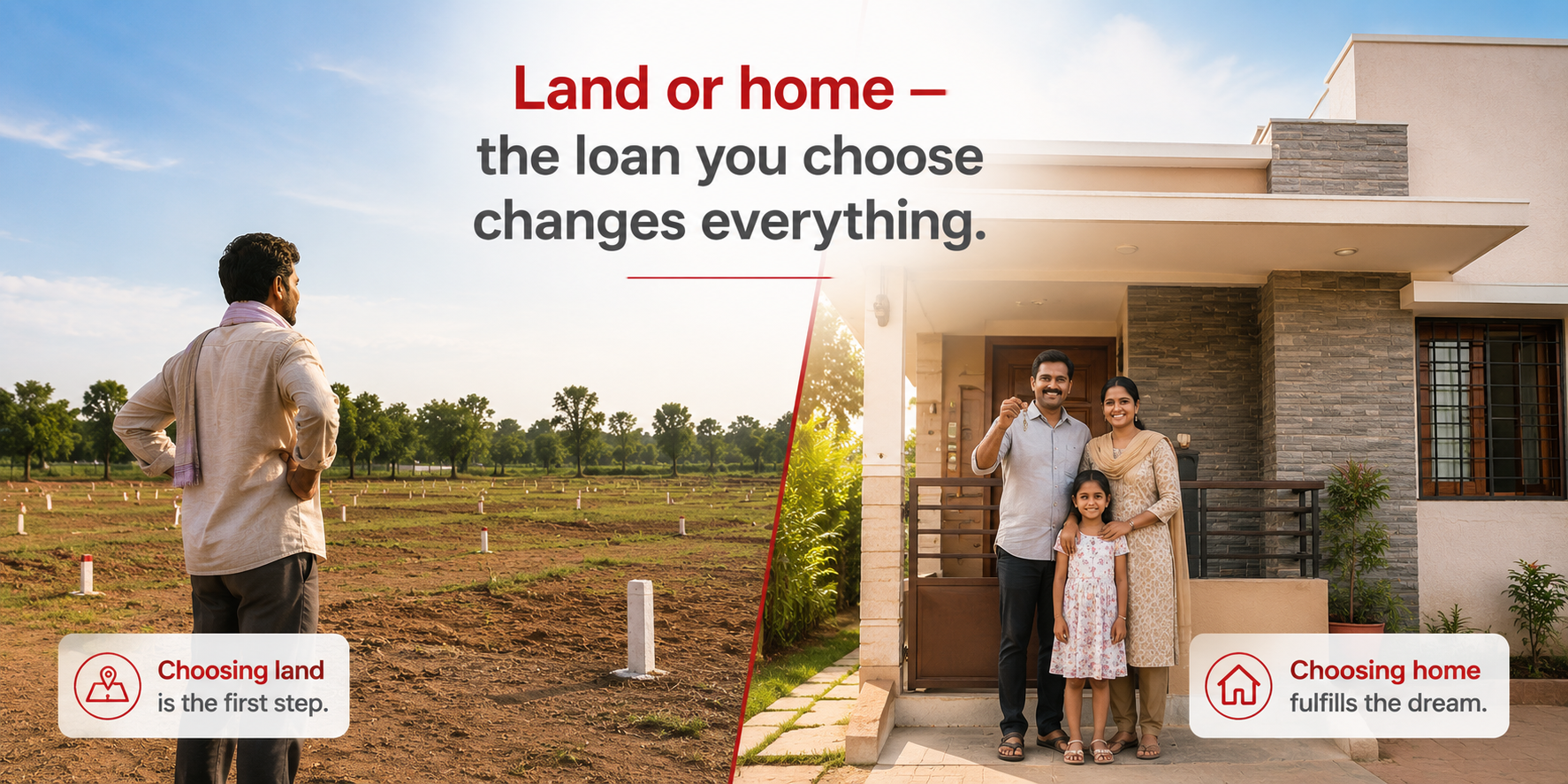
Land is where your story begins. Make sure the loan you choose lets it continue the way you planned.
Frequently Asked Questions
What is the main difference between a plot loan and a home loan?
A home loan is for purchasing or constructing a residential property — a flat, house, or built structure. A plot loan is for purchasing a vacant residential plot. The two products differ in LTV ratios, tax treatment, tenure, and PMAY eligibility. Choosing the wrong product for your need creates financial and tax complications. Easy Home Finance can help you identify the right product from the start.
Can I claim tax benefits on a plot loan?
Not immediately. A standalone plot loan does not qualify for deductions under Section 80C or Section 24(b) of the Income Tax Act. These benefits become available only after construction on the plot is complete and you receive a completion certificate. If you need tax benefits from day one, a home loan on a built or under-construction residential property is the more appropriate product. Consult a CA for guidance specific to your situation.
Is PMAY available on a plot loan?
Generally, no. PMAY interest subsidies are available on home loans for the purchase or construction of residential units. A standalone plot loan typically does not qualify. If you are a first-time buyer who may be eligible for PMAY, structure your financing as a home loan or a composite plot-plus-construction loan. Verify current eligibility at pmaymis.gov.in or speak to our team.
Can I get a loan to buy agricultural land?
No. Both plot loans and home loans are restricted to residential land and properties. Agricultural land purchases are not eligible for standard home or plot loan financing from institutional lenders. If you are considering converting agricultural land to residential use, the conversion must be completed and legally recorded before a plot loan becomes applicable.
What is a composite loan and is it better than a separate plot and construction loan?
A composite loan combines the plot purchase and construction financing into a single loan facility. It can simplify the process, reduce paperwork, and — depending on the lender — may allow access to tax benefits from the point construction begins. Whether it is the better option depends on your specific plan, timeline, and financial profile. Talk to our team — we will assess your situation and give you an honest recommendation.





Leave a Comment