

The One Document That Exposes a Property’s Dark Past — Your EC Explained
Neha found a flat in Pune that seemed perfect. The seller was friendly. The price was fair. The neighbourhood was exactly what she had always wanted. She was ready to sign.
Her loan officer at Easy Home Finance asked one question before she did. “Has anyone pulled the Encumbrance Certificate on this property?”
Nobody had. So they did — and they found an active mortgage from six years ago that the seller had never disclosed. The previous owner had borrowed against the property and never fully settled the loan.
Neha walked away before signing anything. She found another property. And this time, the EC came back clean.
One document. One check. A lifetime of financial security protected.
If you are applying for a home loan and you have never heard of an Encumbrance Certificate — or you have heard the term but aren’t sure what it actually means — this guide will explain everything. Clearly, practically, and without jargon.
What Is an Encumbrance Certificate?
An Encumbrance Certificate — commonly called an EC — is an official document issued by the Sub-Registrar’s office that records every registered transaction that has taken place on a specific property over a specified period of time.
In plain terms, it is the property’s financial and legal history. Every time a property was sold, mortgaged, gifted, or used as security for a loan — and those transactions were registered — that record appears in the EC.
The word “encumbrance” means a claim, liability, or charge on something. Therefore, an Encumbrance Certificate is literally a certificate that tells you whether the property carries any outstanding claims, loans, or liabilities — or whether it is free of all of these.
A property with no such claims is described as having a clear title or being encumbrance-free. This is what every lender — including Easy Home Finance — needs to confirm before approving a home loan.
The EC is governed under the Registration Act, 1908 and is issued based on the records maintained at the local Sub-Registrar’s office where the property is registered.
What Does an Encumbrance Certificate Actually Contain?
An EC typically contains the following information for the period you request:
Property Details
The survey number, plot number, location, and dimensions of the property as recorded in the registration office.
Owner Details
The name of every person who has been recorded as an owner of the property during the period covered by the EC.
Transaction History
Every registered transaction on the property — including sale deeds, mortgage deeds, gift deeds, partition deeds, release deeds, and court attachments — is listed in chronological order. Each entry shows the type of transaction, the parties involved, the date, and the document number.
Outstanding Liabilities
If a mortgage or loan was taken against the property and has not been formally discharged through a registered deed, it will appear as an active encumbrance. This is the most critical piece of information for any buyer or lender.
When the EC shows no registered transactions — or shows only previously completed and discharged transactions — it is described as a nil encumbrance certificate or a clear EC. This is the outcome every buyer wants to see.
Why Does Your Lender Absolutely Need It?
When Easy Home Finance — or any lender — gives you a home loan, the property you are buying becomes the security for that loan. If you are unable to repay, the lender has a legal right over that property.
However, that right is only meaningful if the property is genuinely free of prior claims. Therefore, before any lender disburses a single rupee, they need to be completely certain of three things:
The seller actually owns the property
The EC shows every ownership transfer. If the person selling you the property is not the last recorded owner, that is a serious red flag that requires immediate investigation.
No one else has a financial claim on it
An undisclosed mortgage or loan against the property means the lender who gave that loan may have a prior claim on the property. Your new lender’s security would be compromised — and so would yours.
There are no court attachments or disputes
If a court has attached the property as part of a legal dispute, that attachment is registered and will appear in the EC. Buying an attached property draws you into someone else’s legal battle. No lender will finance such a property.
This is why an Encumbrance Certificate is not optional, negotiable, or a formality. It is a fundamental protection — for the lender and, more importantly, for you as the buyer.
Form 15 vs Form 16 — What Is the Difference?
When you apply for an EC, the Sub-Registrar’s office issues one of two forms depending on what the records show:
Form 15 — Encumbrance Certificate
This form is issued when the records show one or more registered transactions on the property during the period requested. It lists every transaction in detail. This does not automatically mean there is a problem — it simply means the property has a documented history. What matters is whether any of those transactions represent an unresolved liability.
Form 16 — Nil Encumbrance Certificate
This form is issued when the records show absolutely no registered transactions on the property during the requested period. It confirms that the property has no encumbrances on record for that window of time.
Both forms are valid EC documents. A Form 15 with a clean, fully resolved transaction history is just as acceptable to a lender as a Form 16 — as long as there are no active or unresolved liabilities showing.
How Far Back Should an EC Cover?
This is one of the most practical questions buyers ask — and one where clear guidance matters.
Most property lawyers and lenders recommend requesting an EC that covers at least 13 to 15 years of transaction history. This is because the standard limitation period for many property-related legal claims in India is governed by the Limitation Act, 1963, and covering 13 to 15 years provides a reasonable buffer against most types of historical claims.
However, for older properties — or properties with a complex ownership history — requesting a longer period of 20 to 30 years gives an even more comprehensive picture of the property’s legal standing.
When you apply through Easy Home Finance, our legal team specifies the appropriate EC period as part of the property verification process. You do not need to make this judgment call alone.
How to Get an Encumbrance Certificate
The EC is issued by the Sub-Registrar’s office in the jurisdiction where the property is registered. Here is a general overview of how to obtain one:
Offline Application
Visit the Sub-Registrar’s office that has jurisdiction over the property. Submit a written application specifying the property details — survey number, plot number, address — and the period for which you need the EC. Pay the applicable fee and collect the EC once it is processed.
Online Application
Several states have digitised their registration records and allow EC applications online. Here are some portals where this is available:
- Karnataka: kaveri.karnataka.gov.in
- Tamil Nadu: tnreginet.gov.in
- Andhra Pradesh / Telangana: registration.ap.gov.in
- Maharashtra: igrmaharashtra.gov.in
- Kerala: keralaregistration.gov.in
For states not listed here — including UP, MP, and Rajasthan — online EC availability varies by district. Check your state’s revenue or registration department portal for current availability. Because digital access to ECs varies and is subject to ongoing development, we have flagged specific state-level process details in the confidence audit table below.
What If the EC Shows an Active Encumbrance?
This is the moment that separates an informed buyer from an uninformed one.
If the EC shows an active mortgage — a loan taken against the property that has not been formally discharged — do not panic, but do not ignore it either. Here is what to do:
Ask the seller to produce the discharge deed
If the loan has been fully repaid, the lender who gave that loan should have issued a formal discharge deed or release deed. This document, when registered, removes the mortgage from the property’s record. Ask the seller to produce this document and verify its registration at the Sub-Registrar’s office.
Confirm with the original lender
In some cases, even when a loan is fully repaid, the discharge deed may not have been registered. Contact the original lender directly — or ask the seller to do so — and confirm the outstanding position in writing.
Do not proceed until it is resolved
Under no circumstances should you complete a property purchase or allow a home loan to be disbursed until an active encumbrance is formally and verifiably resolved. A verbal assurance from the seller is not enough. A registered discharge deed is what you need.
If you are unsure how to handle an EC that shows active encumbrances, our team at Easy Home Finance is here to guide you. We deal with these situations regularly and can help you understand what is resolvable and what is a genuine red flag.
EC vs Sale Deed — Two Documents, Two Jobs
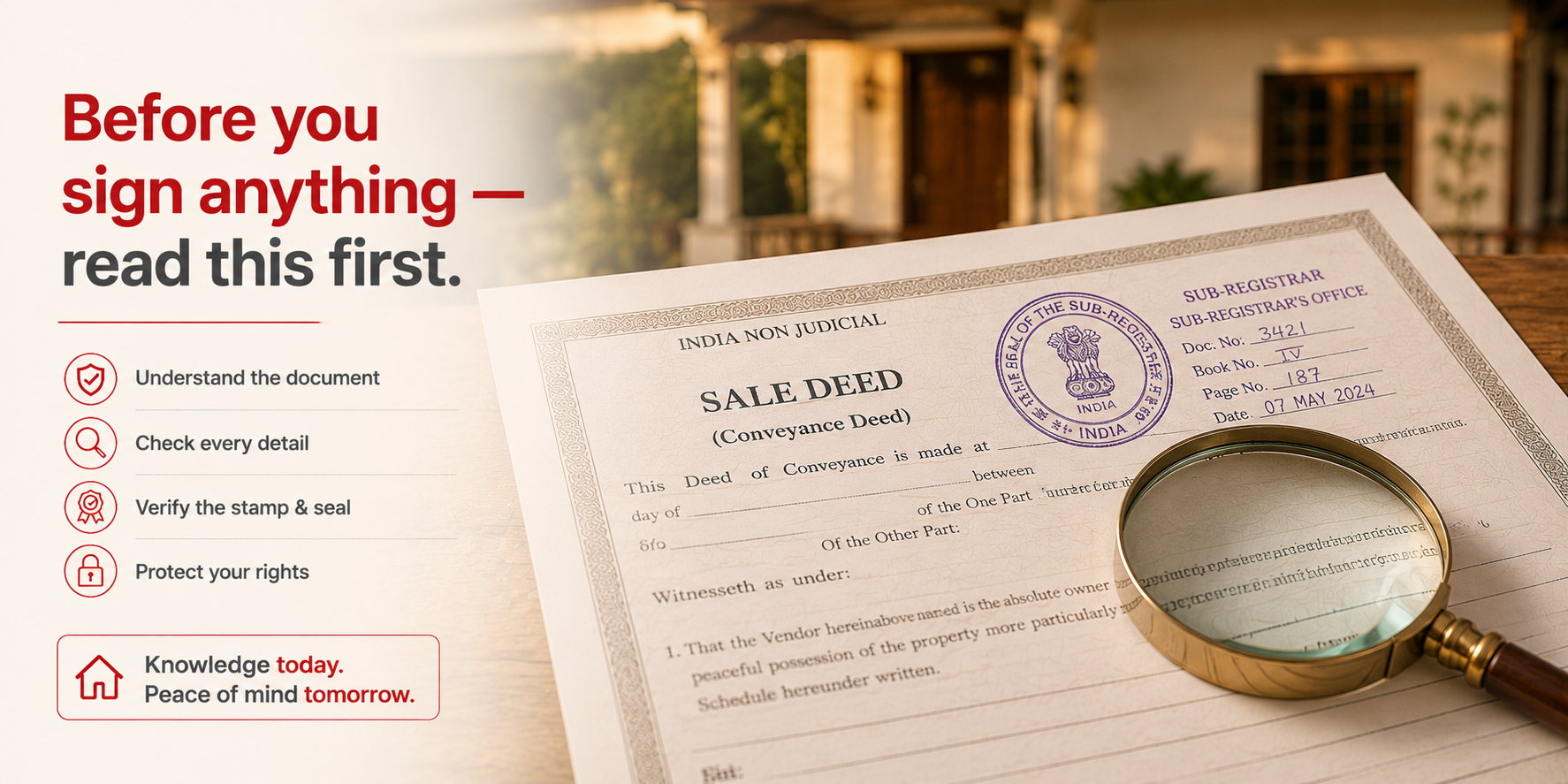
Many first-time buyers confuse the EC with the Sale Deed. They serve completely different purposes.
| Document | What It Does |
|---|---|
| Sale Deed | Legally transfers ownership from seller to buyer |
| Encumbrance Certificate | Records all past transactions and confirms the property is free of liabilities |
Think of it this way. The Sale Deed is the present — it creates your ownership. The EC is the past — it tells you whether the property’s history is clean enough to trust. Both are essential. Neither replaces the other.
At Easy Home Finance, we review both documents — along with the full chain of title documents — as part of every home loan’s legal verification. Our borrowers are protected before they commit, not after.
The Bottom Line
An Encumbrance Certificate is not administrative paperwork. It is your single most powerful tool for verifying that the property you are about to pay for — and the home loan you are about to take — rests on a clean, dispute-free foundation.
Skipping it, or accepting a seller’s verbal assurance in its place, is one of the most expensive mistakes a first-time buyer can make. The good news is that getting one is straightforward — and the protection it provides is absolute.
Easy Home Finance reviews every property’s EC as a non-negotiable part of our loan process. We flag issues early, explain them clearly, and guide you through resolution before any money changes hands.
Here is what to remember:
- An EC records every registered transaction on a property over a specified period
- Form 15 shows transaction history; Form 16 confirms nil encumbrance
- Always request an EC covering at least 13 to 15 years
- An active encumbrance must be formally discharged — a verbal assurance is never enough
- Easy Home Finance conducts a full EC review on every property before disbursal
The property you buy should have a clean past. Let us make sure it does.
Apply for your home loan today — Easy Home Finance protects you at every step.
One certificate. One check. A lifetime of security. Don’t skip it.
Frequently Asked Questions
What is an Encumbrance Certificate and why is it needed for a home loan?
An Encumbrance Certificate is an official document issued by the Sub-Registrar’s office that records every registered transaction — sales, mortgages, gifts, court attachments — on a property over a specified period. It tells your lender that the property is free of undisclosed loans and legal claims. No institutional lender, including Easy Home Finance, will approve a home loan without first verifying a clean EC.
How many years should an Encumbrance Certificate cover?
Most property lawyers and lenders recommend requesting an EC covering at least 13 to 15 years. For older or complex properties, a 20 to 30 year period is advisable. The longer the period covered, the more comprehensive your protection against historical claims. When you apply through Easy Home Finance, our legal team determines the appropriate period for your specific property and jurisdiction.
What is the difference between Form 15 and Form 16 in an EC?
Form 15 is issued when the property has one or more registered transactions on record during the requested period. Form 16 — a nil encumbrance certificate — is issued when there are no registered transactions. Both are valid EC outcomes. A Form 15 with fully resolved transactions is equally acceptable to a lender as a Form 16. What matters is whether any active, unresolved liabilities appear on the record.
What should I do if the EC shows an active mortgage on the property?
Do not proceed with the purchase until the issue is formally resolved. Ask the seller to produce a registered discharge deed or release deed confirming the loan has been repaid. Verify its registration at the Sub-Registrar’s office independently. Never accept a verbal assurance in place of a registered document. If you need guidance on a specific situation, talk to our team — we deal with this regularly and will advise you honestly.
Can I get an Encumbrance Certificate online in India?
Yes — in several states. Karnataka, Tamil Nadu, Maharashtra, Andhra Pradesh, Telangana, and Kerala all have online EC portals. Other states are at varying stages of digitisation. For states where online access is not yet fully available, the EC must be obtained directly from the relevant Sub-Registrar’s office. Consult your state’s revenue or registration department portal for current availability, or ask a local property advocate to assist.






Leave a Comment