

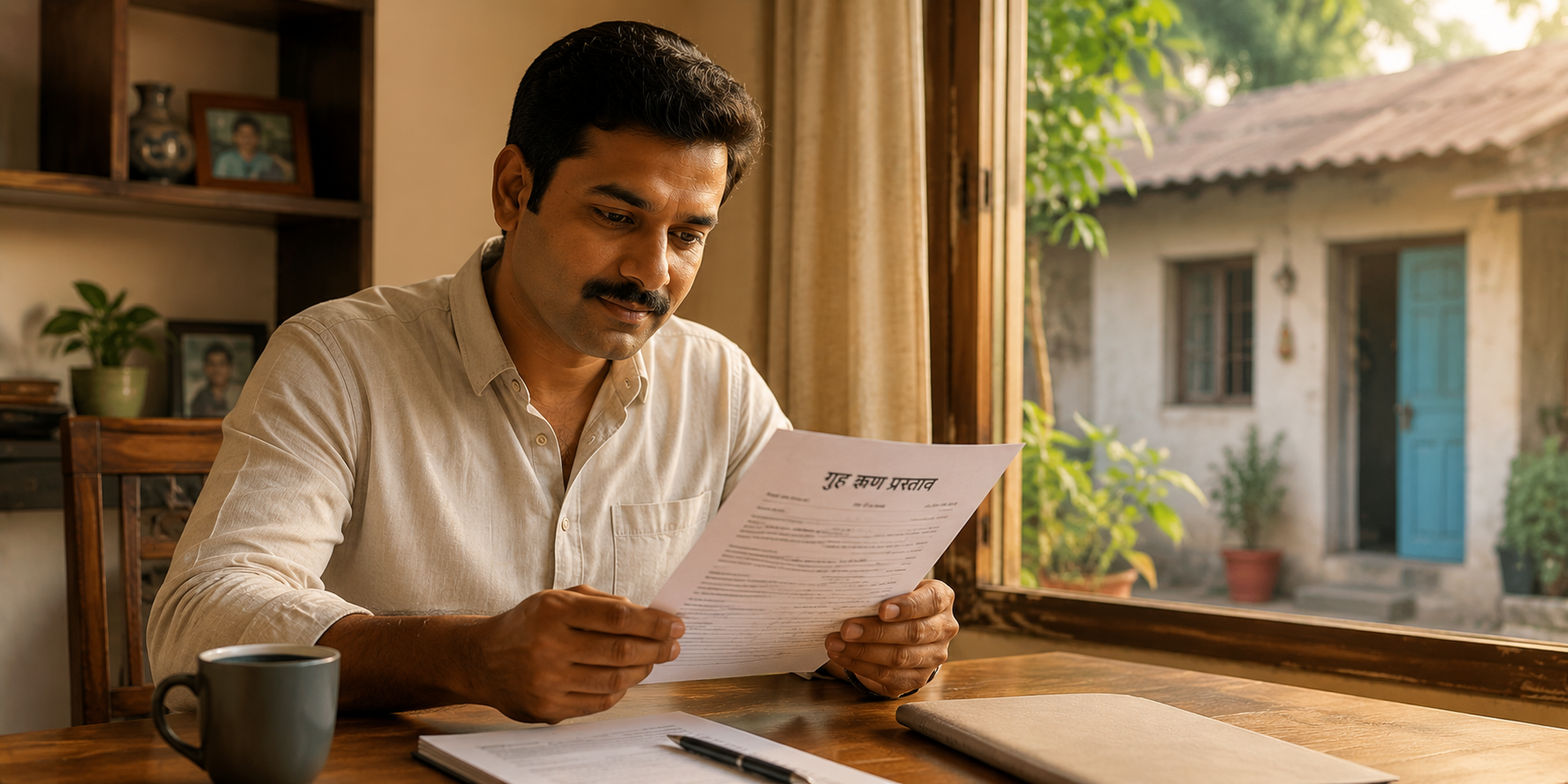
Understand Your Property Documents Before Signing
Priya lives in a small town in Maharashtra. She has been saving for years to buy a small flat. Finally, the seller hands her a stack of documents. Some pages are in Marathi. Some are in English. Some have stamps she has never seen before. The seller says, “Just sign here.” And Priya has no idea what she is signing.
This happens every single day across India — in small towns in UP, in tehsils in Rajasthan, in growing cities in Tamil Nadu and Bengal. Buyers sign documents they cannot read, in languages they do not fully understand, because no one took the time to explain.
That is exactly what this guide is here to change.
If you are applying for a home loan — especially in a tier-2 or tier-3 city — understanding your property documents is not optional. It is essential. So let us walk through every major document, what it is called in common regional languages, and what it actually means for you.
Why Property Documents Are Often in Regional Languages
India’s property registration system is governed by the Registration Act, 1908. Under this law, property documents must be presented to the local Sub-Registrar for registration. In practice, most states require these documents to be in the official language of that state.
Therefore, a sale deed in Maharashtra is typically in Marathi. In UP and MP, it is in Hindi. In Tamil Nadu, it is in Tamil. In West Bengal, it is in Bengali. And in Karnataka, it is in Kannada.
This is entirely legal and normal. However, it creates a very real challenge for first-time buyers — particularly in smaller cities — who may not be fully comfortable reading formal legal language even in their own mother tongue.
Understanding what each document is and what it does is therefore the most important thing you can do before you sign anything and before you apply for a home loan.
The Core Property Documents You Will Encounter — In Any Language
Here are the key documents you will see in any property transaction across India, along with their names in common regional languages and a plain-language explanation of what each one means.
1. Sale Deed (Bikri Patra / Vikri Khat / Vikray Dastaveez)
What it is called:
| Language | Name |
|---|---|
| Hindi | बिक्री विलेख — Bikri Vilekh |
| Marathi | विक्री खत — Vikri Khat |
| Bengali | বিক্রয় দলিল — Bikroy Dalil |
| Tamil | விற்பனை பத்திரம் — Virpanai Pathiram |
| Kannada | ಮಾರಾಟ ಪತ್ರ — Marata Patra |
What it means: The Sale Deed is the most important document in any property transaction. It is the legal proof that the seller has transferred ownership of the property to you. Without a registered Sale Deed, you do not legally own the property — regardless of what you have paid.
Every lender, including Easy Home Finance, will ask for the registered Sale Deed as a primary document before approving your home loan. Make sure it is registered at the Sub-Registrar’s office and that you receive the original after registration.
2. Encumbrance Certificate (EC)
What it is called:
| Language | Name |
|---|---|
| Hindi | भार प्रमाण पत्र — Bhar Praman Patra |
| Tamil | சுமை சான்றிதழ் — Sumai Saandridhal |
| Kannada | ಹೊರೆ ಪ್ರಮಾಣ ಪತ್ರ — Hore Pramana Patra |
| Telugu | భారం సర్టిఫికేట్ — Bharam Certificate |
| Marathi | भार प्रमाणपत्र — Bhar Pramanpatra |
What it means: An Encumbrance Certificate shows the complete transaction history of a property over a specified period. It tells you whether the property has any unpaid loans, mortgages, or legal claims against it.
This is one of the first documents any lender checks. If the EC shows a pending mortgage or a dispute, the loan cannot proceed until it is resolved. Always ask for an EC covering at least the last 13 to 15 years. You can obtain it from your state’s Sub-Registrar office or, in some states, online through the state’s land records portal.
3. Khata / Patta Certificate
What it is called:
| Language | Name |
|---|---|
| Hindi (UP, MP, Rajasthan) | खसरा / खतौनी — Khasra / Khatauni |
| Kannada (Karnataka) | ಖಾತಾ — Khata |
| Tamil (Tamil Nadu) | பட்டா — Patta |
| Marathi (Maharashtra) | सातबारा उतारा — Satbara Utara |
| Bengali (West Bengal) | পর্চা — Parcha |
What it means: This group of documents — called different names in different states — serves a similar purpose everywhere. They are municipal or revenue records that identify the property, confirm who owns it, and record its size and use.
In Karnataka, the Khata is essential for obtaining building approval and utility connections. In Maharashtra, the Satbara Utara (7/12 extract) is one of the most critical land records for rural and semi-urban properties. In Tamil Nadu, the Patta confirms ownership in revenue records.
When you apply for a home loan, lenders use these records to verify that the property exists exactly as described and that it is registered in the seller’s name in the government’s records.
4. Title Deed and Previous Chain of Documents
What it means: A Title Deed is a broader term for the complete chain of ownership documents — every sale deed, gift deed, partition deed, or inheritance record that shows how the property passed from one owner to the next over the years.
A clear title means there are no gaps in this chain. If there is a missing link — for example, an inheritance that was never formally recorded — it creates what lawyers call a “defective title.” Most lenders will not approve a home loan on a property with a defective title.
Therefore, always ask the seller for the complete chain of documents going back at least 20 to 30 years. Our team at Easy Home Finance conducts a thorough legal title check on every property before your loan is sanctioned — so you are protected even if you cannot read the documents yourself.
5. Mutation Record (Dakhil Kharij / Ferfar / Khatauni)
What it is called:
| Language | Name |
|---|---|
| Hindi (UP, Bihar, MP) | दाखिल खारिज — Dakhil Kharij |
| Bengali | নামজারি — Namjari |
| Marathi | फेरफार — Ferfar |
| Rajasthan | नामान्तरण — Namantaran |
What it means: Mutation is the process of updating the government’s land revenue records to reflect a change of ownership. When you buy a property, you must apply for mutation so that the revenue records show your name as the new owner.
Mutation does not in itself prove legal ownership — that is the job of the Sale Deed. However, it is important for paying property taxes in your name and for future transactions involving the property. Many first-time buyers in smaller towns skip this step, which causes problems later.
6. Approved Building Plan and Completion Certificate
What it means: For any constructed property — a flat, a house, or a plot with a building — two additional documents matter significantly.
The Approved Building Plan shows that the local municipal authority approved the construction layout. The Completion Certificate (sometimes called an Occupancy Certificate) confirms that the building was constructed as per the approved plan and is fit for occupation.
Without these documents, your property may technically be an unauthorised construction — which makes it very difficult to get a home loan. Always ask the builder or seller for both documents before you commit. And always verify with your local municipal authority that the approvals are genuine.
What To Do If You Cannot Read the Documents
Here are four practical steps for any tier-2 or tier-3 buyer who receives documents in a regional language they cannot fully read:
Step 1 — Do not sign under pressure Take the documents home. Ask for time. Any genuine seller will give you time to review. If someone pressures you to sign immediately, that is a red flag.
Step 2 — Ask a local advocate for a plain-language summary A property lawyer in your city will typically charge a modest fee to review documents and explain their contents in simple terms. This small cost can save you from enormous problems later.
Step 3 — Use your state’s online land records portal Many states have digitised their land records. You can independently verify key details — ownership, encumbrances, dimensions — online, without relying entirely on what the seller shows you.
Step 4 — Let your lender’s legal team review everything When you apply through Easy Home Finance, our legal and technical team reviews every document as part of the loan process. We flag issues before your loan is disbursed — not after. This is one of the most valuable protections a formal home loan gives you.
Talk to our team before you sign anything.
State Land Record Portals You Can Use Right Now
Many states have made land records available online. Here are some you can use to independently verify property details:
- Uttar Pradesh: upbhulekh.gov.in
- Madhya Pradesh: landrecords.mp.gov.in
- Rajasthan: apnakhata.rajasthan.gov.in
- Maharashtra: bhulekh.mahabhumi.gov.in
- Karnataka: landrecords.karnataka.gov.in
- Tamil Nadu: eservices.tn.gov.in
- West Bengal: banglarbhumi.gov.in
These portals allow you to check ownership records, survey numbers, and in some cases, encumbrance history — directly and independently, without relying on the seller.
The Bottom Line
Property documents in regional languages are not meant to confuse you. They are the official records that protect your ownership rights. However, not understanding them is a real risk — especially for first-time buyers in smaller cities who are also navigating a home loan for the first time.
The solution is simple. Learn what each document is called and what it does. Use your state’s online land records portal to verify independently. And always work with a lender like Easy Home Finance who checks these documents thoroughly on your behalf.
Here is what to remember:
- The Sale Deed is your most important ownership document — ensure it is registered
- The Encumbrance Certificate confirms the property is free of loans and disputes
- Khata, Patta, Satbara, and Khatauni are state-specific revenue records — all important
- Mutation updates government records to show your name as the new owner
- An Approved Building Plan and Completion Certificate are essential for constructed properties
- Easy Home Finance conducts legal and technical checks on every property before loan disbursal
You have worked too hard to sign something you don’t understand. Let us help you get it right.
Apply for your home loan today — we check every document for you.
In every language, in every state, your home is worth understanding.
Frequently Asked Questions
Why are property documents in regional languages in India? Under the Registration Act, 1908, property documents are registered with the state’s Sub-Registrar office. Most states require these documents to be in the official state language. Therefore, documents in Maharashtra will be in Marathi, in UP in Hindi, in Tamil Nadu in Tamil, and so on. This is completely normal and legally valid.
Can I get a home loan if my property documents are in a regional language I can’t read? Yes. Your lender’s legal team will review the documents as part of the loan process. At Easy Home Finance, we conduct a full legal and technical check on every property before approving your loan — regardless of the language the documents are in. However, it is always advisable for you to personally understand what you are signing.
What is the difference between an Encumbrance Certificate and a Sale Deed? The Sale Deed is the document that transfers ownership from the seller to you. The Encumbrance Certificate is a record that shows the entire history of transactions on a property — including any past loans or disputes. Both are essential for a home loan. The EC confirms the property is free of existing financial claims before the new Sale Deed is executed.
What is mutation and why does it matter after buying a property? Mutation — called Dakhil Kharij in Hindi, Namjari in Bengali, and Ferfar in Marathi — is the process of updating the government’s land revenue records to show your name as the new owner. While it does not replace the Sale Deed as proof of ownership, it is important for property tax payments and future transactions. Most buyers in smaller cities overlook this step, which causes complications later.
How do I verify a property’s documents independently before applying for a home loan? Most states have online land record portals where you can verify ownership, survey numbers, and encumbrance details. For example, UP uses upbhulekh.gov.in, Rajasthan uses apnakhata.rajasthan.gov.in, and Maharashtra uses bhulekh.mahabhumi.gov.in. Additionally, Easy Home Finance conducts an independent legal and technical check on every property as part of our loan process.






Leave a Comment